
[DRAFT] Common definitions
Terms and definitions
- Last reviewed
- 4 August 2026
- Owner
- Head of Architecture
Activities and tasks
Activities and tasks are the things people do when they use a service, including:
- finding out how something works
- calling people for help
- applying for something
- gathering evidence
- waiting and worrying about what might happen
- being notified about a result
- calling to find out what is happening
Activities can also describe things that need to happen to make a service work, whether carried out by people or computers, for example:
- checking eligibility
- checking suitability
- making a decision
- notifying someone about a decision
- revoking permission
Activities should describe what happens, but not how it happens, by whom or with what. So, we’d use ‘notifying someone’ rather than ‘sending a letter’ and ‘making a decision’ rather than ‘casework’.
For example, a claims advisor deciding how much someone’s insurance claim is worth (activity) may use several systems to look-up data about the individual (tasks).
Capability
A capability is an abstract concept used to describe what we do, but not how we do it. They describe the things we do to define and deliver our goals. They are realised through:
- people
- processes
- information
- technology
- other resources
Capabilities help us understand whether we have the expertise, knowledge, tools, organisation and capacity needed to achieve something.
They are often grouped into categories:
- strategic capabilities describe high-level goal-setting activities.
- core capabilities describe core activities an organisation performs to achieve its goals
- enabling capabilities are activities that support other capabilities rather than directly delivering organisational goals
Capabilities can also be broken down into levels, usually no more than the 3 listed above.
For example, as part of setting policy for 'schools policy' (a strategic capability), DfE might define an organisational need to deliver 'curriculum design' (a core capability). This will require people, processes, information, technology and other things. These may in turn rely on other capabilities, such as communications or finance, to support their delivery (enabling capabilities).
Common components
A common component is a software or technical system that is created once and reused many times across services or business contexts. They are building blocks that support business or technical capabilities and help deliver modular services and systems.
Components are often used alongside design patterns. A pattern describes a reusable solution to a common problem, within a given context.
Common components can be any size but all share the same characteristics. They are:
- designed according to common standards, principles and patterns, with independent quality assurance to ensure the principles and patterns have been applied
- designed and developed in a modular, scalable and resilient way to support ease of reuse and reliability
- mapped to a specific business or technical capability or service. This enables easy search and prevents duplication
- treated as an asset and therefore require asset lifecycle management – support wrap, continuous improvement, enhancement or replacement
- standalone but interoperable with other common components, such that change to one does not cause a ripple effect change to others
In a mature organisation, common components help us build services and products faster by reusing existing functionality.
Examples of common components include DfE Sign-in, providing identity and access management, and the Enterprise Data and Analytics Platform (EDAP), for strategic data management.
Read more about common components.
Data
Data is the information generated by, or used to carry out, activities and services. We describe data using clear terms, such as, National Insurance number and avoid acronyms where possible.
Data can be thought of in 2 ways.
Operational data, generated by the operation of a service. An example would be user completion rates on a digital service.
Intelligence data, generated to support decision making. This could also be considered as information - data that has been ordered or analysed and provides meaning, more than data alone. For example, customer satisfaction or census data. We ask a conscious question from our users, in order to generate meaning.
Data can sometimes be provided as a service for internal or specialist end users, for example, through registers or other databases, Application Programming Interfaces (APIs), standards and permission or usage based controls.
DDaT and DDT
Digital, Data and Technology (DDaT) was rebranded as Government Digital and Data (GDD) in 2023. It's a UK Civil Service profession led by the Government Digital Service (GDS) and characterised by the Government Digital and Data Profession Capability Framework.
Digital, Data and Technology (DDT) is used within DfE to describe the community of people working in digital, data and technology roles across the department.
Engine
An engine is a reusable set of services and components that accelerates digital delivery of similar business capabilities across DfE.
Engines realise patterns and standards, removing complexity and simplifying compliance for delivery teams, whilst ensuring consistency and quality of data.
We classify engines as either data, business, or front-end, to align with DfE target architecture.
Examples include an eligibility checking or funding business engine, an organisation or person data engine, or a whole front-end engine.
Feature
A feature is something a product or service lets users do. Features help people complete tasks or achieve outcomes.
They can help you understand the difference between products and services and decide which one best meets your needs.
Examples include, collaboration tools such as Teams include features like video calls, voice calls and instant messaging.
Or the National Careers Service product Discover your skills and careers includes a job search feature that helps users explore different careers and learn more about them. This is different from a job search feature on a recruitment website, which helps users find and apply for current job vacancies.
Although both are called job search features, they help users achieve different goals.
Organisation
An organisation is an entity structured to achieve objectives. For DfE, these objectives are usually linked to policy outcomes or departmental missions.
Organisation structures are often represented as maps, showing relationships and flows between organisational units.
Organisation maps are different from organisation trees, which are focused on hierarchies and reporting lines.
To help teams understand an organisation and make better decisions, organisation maps are often used alongside:
- capability maps and models
- value streams
- other architecture artefacts
Pattern
A pattern is a reusable common solution to a common problem. It helps teams follow standards and use approaches that have worked well before.
Patterns are used when a solution has been successful in one situation and is likely to work in similar situations.
They provide consistent, proven ways to solve problems. A pattern might be a standard, a recommended way of meeting a standard, or a reusable solution for a specific need.
Patterns explain:
- what problem they solve
- when to use them
- how to use them
- the benefits and trade-offs to consider
Patterns often work alongside components. Components are the building blocks you use to create services and products.
A design pattern is any pattern that helps with service design, software architecture or software development.
Read how patterns fit into the DfE standards framework.
Platform
A platform is something you can build a product or service on. Platforms are collections of technologies that provide a foundation for:
- applications
- products
- services
- processes
Examples of technology platforms in use in DfE include the Cloud Infrastructure Platform (CIP) and the Find and Use an API platform.
GDS offer Government as a Platform services, described as ‘common core infrastructure of shared digital systems, technology and processes on which it’s easy to build brilliant, user-centric government services'. Examples include GOV.UK Pay and GOV.UK Notify.
Product
A product helps meet one or more user needs. A digital or technology product is usually a piece of software.
Products can vary in size and can be grouped together and integrated to create a service. Typically, a service is a larger collection of products which are grouped together to help a user to achieve an outcome.
An example is the National Careers Service product Discover your skills and careers. It’s a standalone product but is best used as part of the user journey across the wider service. This helps a user achieve the outcome of defining a career path and developing their skills to be successful in that career.
Some examples of technology products, used to enable a service, might be Microsoft Dynamics 365 or Salesforce. These are Commercial-Off-The-Shelf (COTS) products that, amongst other things, provide Customer Relationship Management (CRM) capabilities.
Register
A register is the single place to find authoritative information about a specific subject or domain. It must have a data controller or steward who is responsible for ensuring the information contained on a register is kept up to date, accurate and accessible.
For example, the Foreign and Commonwealth Office (FCO) maintains a register of countries. It's a single, maintained list of countries. Any service can connect to this register to provide a single, consistent and authoritative list to its users.
Technology maintain a register of all Services, Products, Technology and Platforms, called the Configuration Management Database (CMDB).
Roles
Definitions of service roles can sometimes be confusing.
For example, a service owner for a public-facing service may have different responsibilities from a service owner for an internal service.
Roles are defined in the Government Digital and Data Profession Capability Framework and may feature as part of our common definitions in the future.
Service
A service is:
Everything the user needs to do to achieve a goal. It is the end-to-end journey that helps a user achieve something.
Services are defined from the user's perspective.
Examples include:
- get a passport
- become a teacher
- learn to drive
- become an apprentice
In DfE, a user could be a student, a teacher, a parent or guardian, a child, an external training provider, a civil servant - anyone that needs to do something, where they or government has a particular outcome to achieve.
A service is a collection of ‘things’ that users interact with that help them achieve their goals. As a result, a service creates an ongoing and consistent relationship between an organisation and its users. ‘Things’ users interact with could be, digital products, call centres that offer support, business processes, communications, interaction with users - any constituent part of a whole service.
Important things to know about services:
- services come and go
- services have a lifecycle
- digital is just one aspect of the service
- services are continuously improved
- they deliver policy outcomes
Services work:
- end-to-end: from where a user starts to explore and understand what they have to do, to the goal they set out to complete
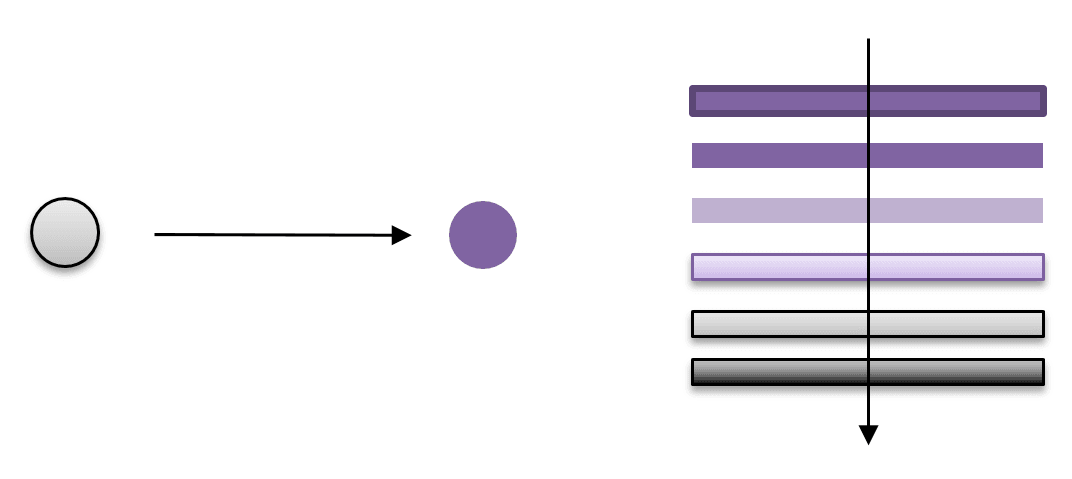
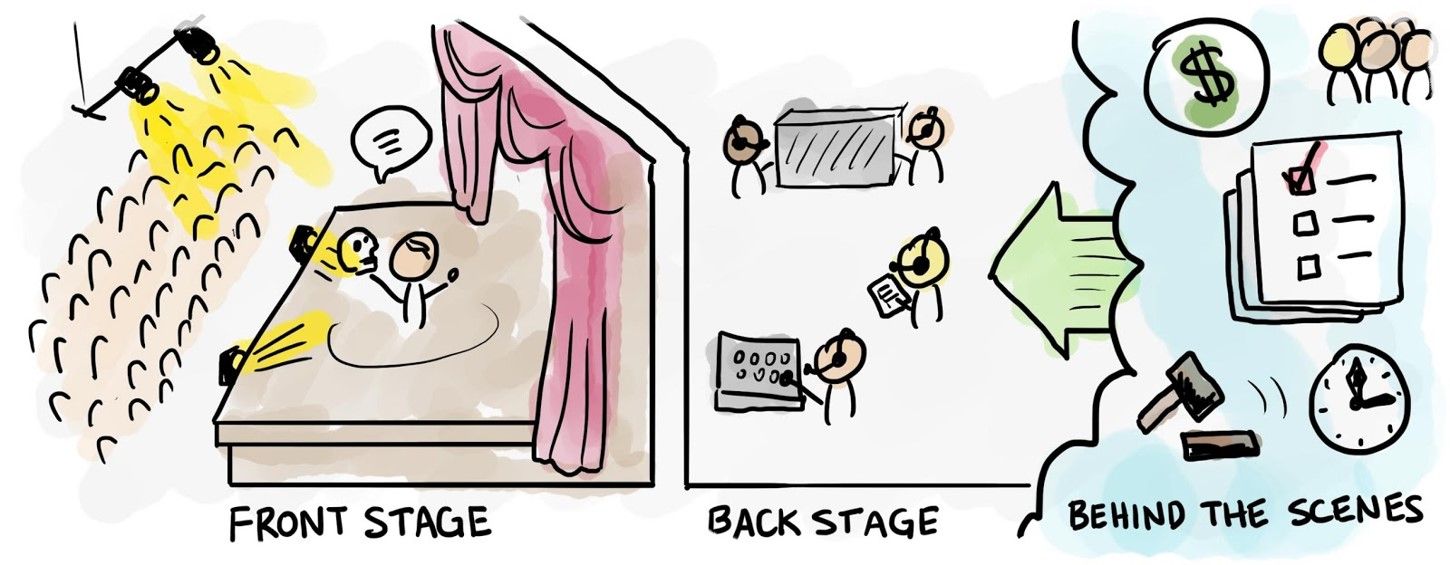
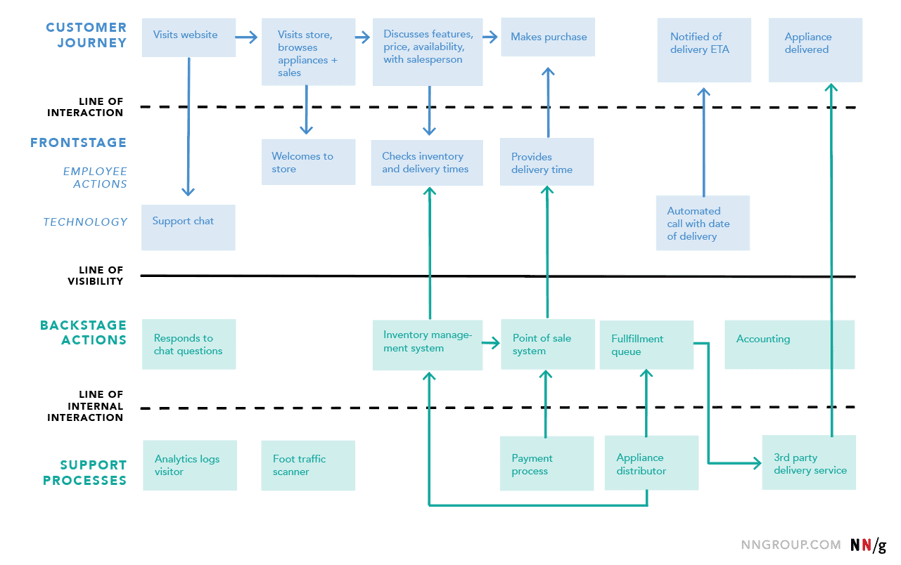
- front-to-back: from the parts of the service users interact with, such as online services, phone calls or face-to-face support, through to the processes and systems that support them, and the behind-the-scenes activities that users do not see, such as governance, funding and financial management
A useful analogy is a theatre performance, where some things happen in front of the audience and others happen behind the scenes.
People often map these elements using a service blueprint.
Every service should have an owner who is accountable for improving the service, managing the day-to-day operations of the service and ensuring it continues to deliver value to its users and the organisation.
We often talk about internal and external services.
Internal services support the running of the department. Examples include finance, commercial and human resources (HR) services.
External services are provided to people and organisations outside the department, such as learners, teachers and schools. Examples include the Apprenticeship Service and the Teacher Vacancies service.
Both internal and external services help users achieve their goals, but they serve different audiences and needs.
Standard
DfE standards are established norms or requirements that we must comply with, to enact policies.
Read the full definition of standards including legal and regulatory obligations, industry standards and organisational standards.
Technology
Technology covers the systems, tools, platforms and applications we build, maintain and buy. It exists to support products, activities and capabilities, enabling us to deliver faster, clearer, simpler services.
For example, a cloud hosting platform would be considered a type of technology.
Value stream
A value stream is a high-level representation of how an organisation creates value for stakeholders. In the public sector, value is often linked to policy outcomes and objectives.
A value stream describes the sequence of activities an organisation carries out to deliver that value or achieve those outcomes.
Value streams are often shown as a map that helps people understand the flow of work and the relationships between activities.
They are commonly used to describe how an organisation works, helping teams make better decisions and identify opportunities for improvement.