
Architecture design governance and assurance
How architecture design assurance works
- Last reviewed
- 4 June 2026
- Owner
- Head of Architecture
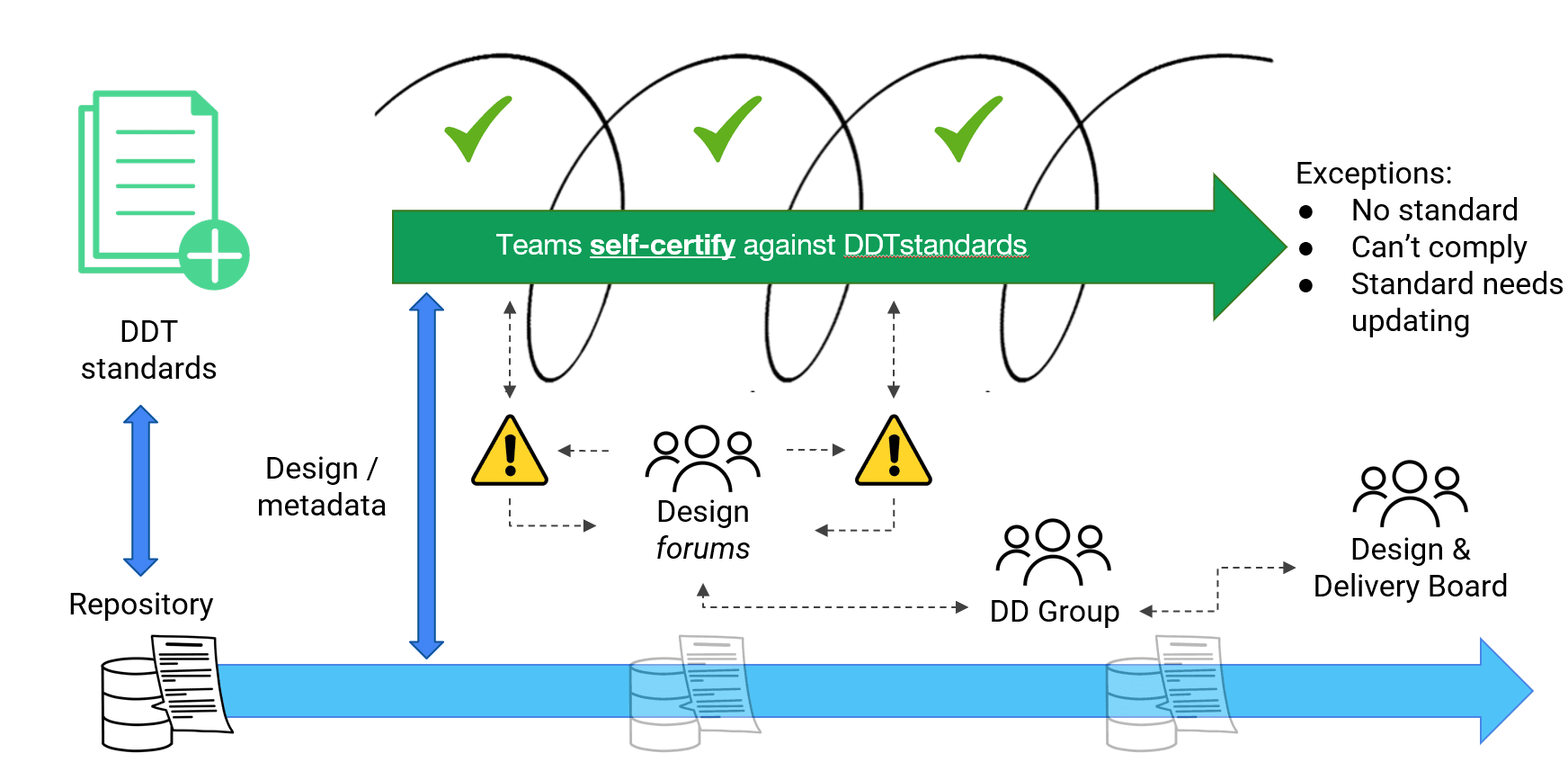
Self-certification
During each design sprint, the person or team responsible for the design will search DfE guidance and repositories for principles, standards or patterns that is applicable to their work. Where these artefacts exist, the design would be expected to comply and follow the guidance provided. If compliance is achieved within the design, the delivery team do not need to seek any further approvals. This is self-certification.
Guidance and repositories:
- Find and use standards
- Accessibility and inclusive design manual
- Design manual
- User research manual
- Technical guidance
- Architecture guidance
- Data architecture repository (opens in new tab, DfE SharePoint users only)
- Cyber and information security (opens in new tab, DfE SharePoint users only)
The team will also need to determine whether their design will close any existing exemptions. They can do this by searching Find and use DDT standards for known exemptions.
If exemptions do need to be closed, this should be done on the Service Health Check App (opens in new tab, DfE SharePoint users only). KvKV If not, the delivery team can proceed, and ensure they maintain the design in an appropriate repository for the service.
Where guiding artefacts do not exist, then the team are free to design their solution to meet their user needs.
If artefacts cover part, but not all of a design, only the parts within scope of those artefacts are expected to be aligned with. In this instance, the team should consider what should exist to cover the gap and discuss this with the standard owner or the DDT standards forum, to highlight the gap.
Should the need for a new standard, pattern or other artefact emerge during design work, this should also be raised with the DDT standards forum for discussion.
Managing an exemption
Where compliance with one or more artefacts cannot be achieved, then an exemption should be raised on the Service Health Check App (opens in new tab, DfE SharePoint users only) before proceeding with the delivery of the design.
This can result in a number of outcomes, depending on the nature of the exemption.
Minor exemptions
Where there is a short-term reason not to comply with a standard, or a pre-existing design precludes compliance, this should be discussed with the standard owner.
Considering the nature if the non-compliance and options for how - and when - the design could be made to comply would likely result in a temporary exemption. This will include conditions for the exemption - typically, the agreed timescales in which compliance may be achieved, how it would be monitored, or further exemption sought. For example, a pre-existing platform choice may be granted exemption for a service until it is next due for contract renewal.
Standard challenge
Where the standard is considered overly limiting on the design, so intentional non-compliance is likely, the design and reasoning should be discussed with the standard owner. They will consider any concerns and investigate whether the standard is still appropriate, establishing if it needs updating or replacing.
A temporary exemption may be applied whilst the standard is reviewed, but this will always carry a constraint that the team will need to align with the updated standard within a prescribed period of time (regardless of whether the standard is changed or not as part of the review).
Major exemption
Where non-compliance is more significant or complex, the DDT standards forum will arrange a review, at pace, pulling in a range of subject-matter experts and perspectives to ascertain whether an exemption is possible and the conditions that would be applied.
Exemption review
In all exemption cases, there will be a timeframe agreed to reach compliance, in which the delivery team will need to review the exemption and update their design. If the design then complies, the team must ensure they update the design in their repository.
Where a decision can’t be made
In all cases where the delivery team wish to dispute the terms of an exemption or the appropriateness of any specific artefact, and consensus cannot be reached by a design forum, then an escalation process is available.
This will be facilitated by the DDT standards forum, who will escalate to a group of nominated Deputy Directors from the DDT Senior Leadership Team.
If a consensus cannot be achieved at this level, the dispute will be escalated to the DDT Design and Delivery Board for review and a decision.